The Macro Decision Engine : Part 1/10
"The Economic Cycle"

Understanding the Cycle Before You Risk Capital
Markets do not suffer from a shortage of information. Every day brings another inflation print, labour market release, central bank speech, earnings update, geopolitical headline, liquidity injection, bond auction, positioning report, or price move that demands interpretation. There is always more data, more commentary, more noise and more urgency.
The real challenge is not access to information. The real challenge is hierarchy. What matters? What does not? What is already priced? What changes the distribution of outcomes? What creates an opportunity worth risking capital on?
Most market participants approach this problem backwards. They begin with price action, search for a narrative that explains it, and then try to retrofit a trade around that narrative. The chart moves first, the story comes second, and the trade is often built last, usually under pressure.
A more robust macro process works in the opposite direction. You begin by identifying the environment, then isolate the dominant themes, assess what the market has already priced, build an evidence base, test that evidence across asset classes, and only then decide whether there is a trade worth taking.
That is the purpose of this series.
Over the coming weeks (10 parts), we are going to build what I call the Macro Decision Engine a repeatable framework for converting information into alpha. This is not designed to be a forecasting machine. Markets are too complex, reflexive and adaptive for that. The objective is not to predict every payrolls print, every central bank decision, or every move in yields.
The objective is to build a structured process for making better decisions under uncertainty. Because in macro, the edge rarely comes from knowing one thing that nobody else knows. More often, it comes from organising widely available information better than the market is currently organising it.
What This Series Will Cover
By the end of this series, the goal is to have a complete framework for moving from macro information to market expression. Each module will build on the previous one, starting with the broad environment and gradually moving toward trade selection, risk construction and process improvement.
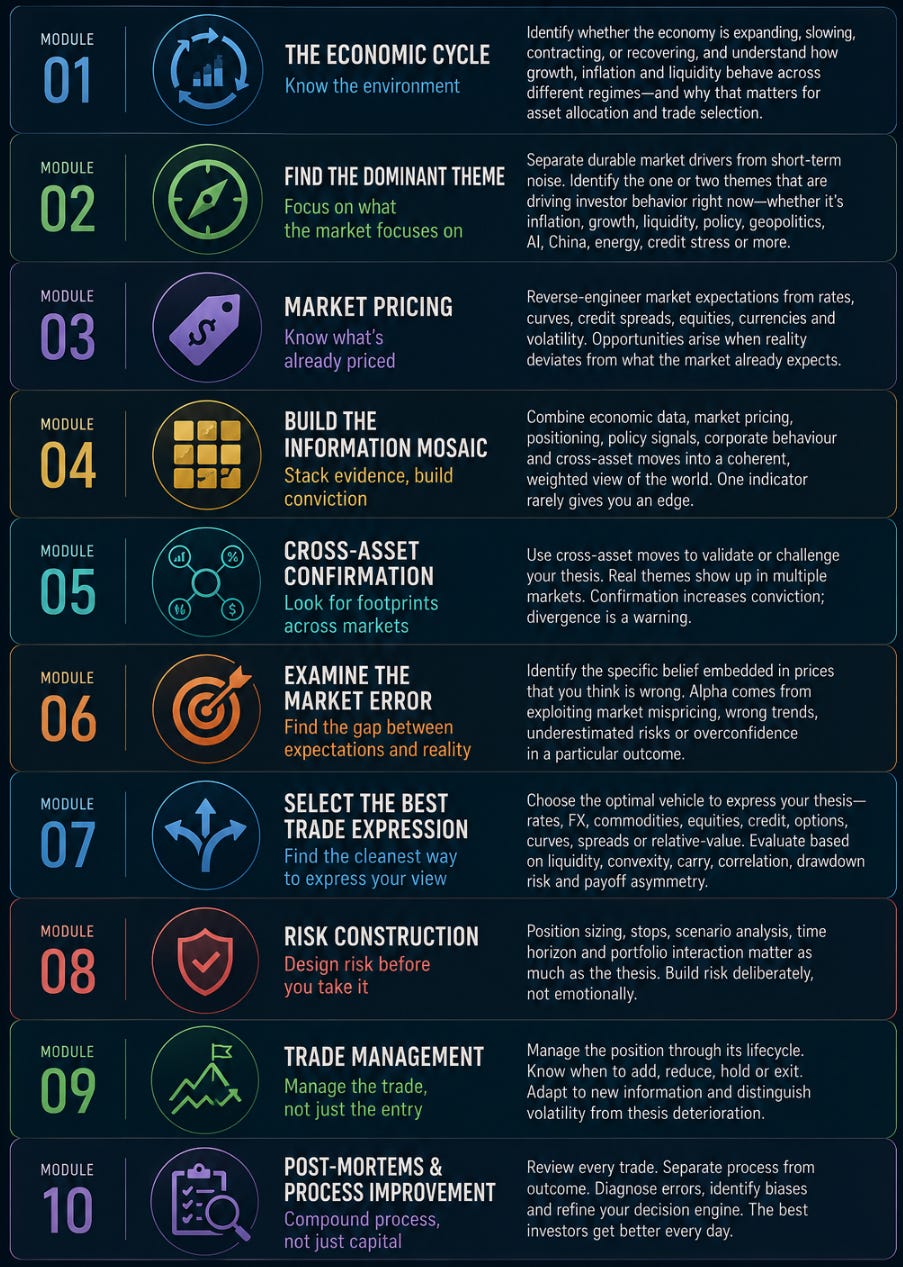
Module 1 begins with the foundation of every macro decision: the economic cycle. Before forming a view on rates, equities, currencies, commodities, or credit, you need to understand the environment you are operating in. Growth, inflation and liquidity behave differently across different regimes, and the same data point can have very different market implications depending on the cycle. This module will focus on identifying whether the economy is expanding, slowing, contracting, or recovering, and why that matters for asset allocation and trade selection.
Module 2 will focus on finding the dominant theme. Markets are not driven by all information equally. At any point in time, investors collectively decide what matters most. Sometimes it is inflation. Sometimes it is growth. Sometimes it is liquidity. Sometimes it is fiscal policy, geopolitics, AI, China, energy, credit stress, or central bank credibility. This module will look at how to separate durable market drivers from short-term noise.
Module 3 will move into market pricing. Being right is not enough. You also need to know what is already priced. If the market already expects rate cuts, weaker growth, lower inflation, or stronger earnings, then the opportunity depends on whether reality deviates from those expectations. This module will look at how to reverse-engineer market expectations from rates, curves, credit spreads, equities, currencies and volatility.
Module 4 will build the information mosaic. One indicator rarely gives you an edge. Macro conviction comes from assembling multiple pieces of evidence into a coherent mosaic. This module will formalise the process of informational edge stacking: combining economic data, market pricing, positioning, policy signals, corporate behaviour and cross-asset moves into a weighted view of the world.
Module 5 will focus on cross-asset confirmation. Macro views should not live in isolation. If a theme is real, it should usually leave footprints across more than one asset class. A growth scare should appear in rates, credit, equities, commodities and FX. An inflation scare should affect the front end, breakevens, commodities and the currency complex. A liquidity impulse should show up in risk appetite, volatility and funding markets. This module will show how to use cross-asset confirmation to test whether the market is validating or rejecting your thesis.
Module 6 will examine the market error. Alpha comes from the gap between expectations and reality. The best macro opportunities often emerge when the market is focused on the wrong variable, extrapolating the wrong trend, underestimating a policy shift, or mispricing the distribution of outcomes. This module will focus on identifying the specific belief embedded in prices that you think is wrong.
Module 7 will focus on selecting the best trade expression. A good macro thesis is not the same thing as a good trade. The same view can often be expressed through rates, FX, commodities, equities, credit, options, curves, spreads, or relative-value structures. This module will examine how to choose the cleanest and most attractive expression for a macro view, based on liquidity, convexity, carry, correlation, drawdown risk and payoff asymmetry.
Module 8 will move into risk construction. The quality of a trade is determined before the entry. Position sizing, stop placement, scenario analysis, time horizon and portfolio interaction all matter as much as the thesis itself. This module will cover how to construct risk deliberately rather than emotionally.
Module 9 will focus on trade management. Most traders spend too much time on entry and not enough time on management. After a position is live, the decision-making burden increases. You need to know when to add, reduce, hold, exit, or invalidate the thesis. This module will cover trade lifecycle management: scaling, profit-taking, reassessing evidence, adapting to new information and distinguishing volatility from thesis deterioration.
Module 10 will cover post-mortems and process improvement. The best traders compound process, not just capital. Every trade should improve the system, whether it makes money or loses money. This module will look at how to review decisions, separate process from outcome, diagnose errors, identify behavioural biases and refine the decision engine over time.
The final module will bring everything together. By the end of the series, the objective is to have a complete framework that allows you to move through the same sequence every time: where are we in the cycle, what is the dominant theme, what is already priced, what evidence supports the view, what contradicts it, is there cross-asset confirmation, where is the market wrong, what is the best expression, how should risk be constructed, and how will I know if I am wrong?
That is the Macro Decision Engine. It is not a promise of certainty. It is a process for operating intelligently in uncertainty. And that is where macro investing begins.
Sign up for the coming growth phase of Global Macro Method, and access to my website www.globalmacromethod.com