
Informational Edge Stacking - Part V
Bond/Rate Proxies to Support Macro

By now, the mosaic has done what it’s supposed to do: it’s taken us beyond staring at a single index chart and into the market’s internal leadership, who is being paid, who is being faded, and what that implies about the cycle.
But there’s a layer underneath all of that which quietly governs whether trends are allowed to persist.
It’s not the CPI print. It’s not the dot plot. It’s not even “growth” in the abstract.
It’s the market’s comfort with the price of money, particularly out the long end.
Because you can have a tape that looks perfectly healthy on the surface, while the discount rate is doing the slow work of tightening the screws. You can also have a market that holds together even as growth wobbles, because the long end is doing the opposite, releasing pressure, quietly reopening the duration trade.
If you want a single framing: most regime shifts show up first as a leadership rotation between operating leverage and equity duration.
That’s what this part is about.
In this post, I’m going to show two ratios, built entirely from liquid sector ETFs, that act as an equity-market read on term premium, curve comfort, and long-end sensitivity. Not as signals. As context. As a way to keep your narrative honest when the index is doing a great job of hiding what’s really going on underneath.

If you’ve ever found yourself thinking:
“Why are equities still up if long-end yields are rising?”
“Why does the index feel fine but the market is trading like it’s one data print away from breaking?”
“Why does every rally suddenly feel rate-dependent?”
These are the tools that help answer those questions, without overfitting, without pretending you can time the turning point, and without letting the market’s headline strength lull you into the wrong expression.
And more importantly, these ratios give you a clean way to separate two very different worlds that often look identical in the index:
A market that’s rising because cyclicality and balance sheets are being sponsored (the “real” risk-on).
A market that’s rising because duration proxies are being accumulated (a very different regime, with very different failure modes).
That distinction matters if you trade rates, curves, STIR, or index futures, because it changes what you press, what you fade, and where the asymmetry actually lives.
Cyclicals vs Bond Proxies
An equity-market read on term premium and long-end comfort
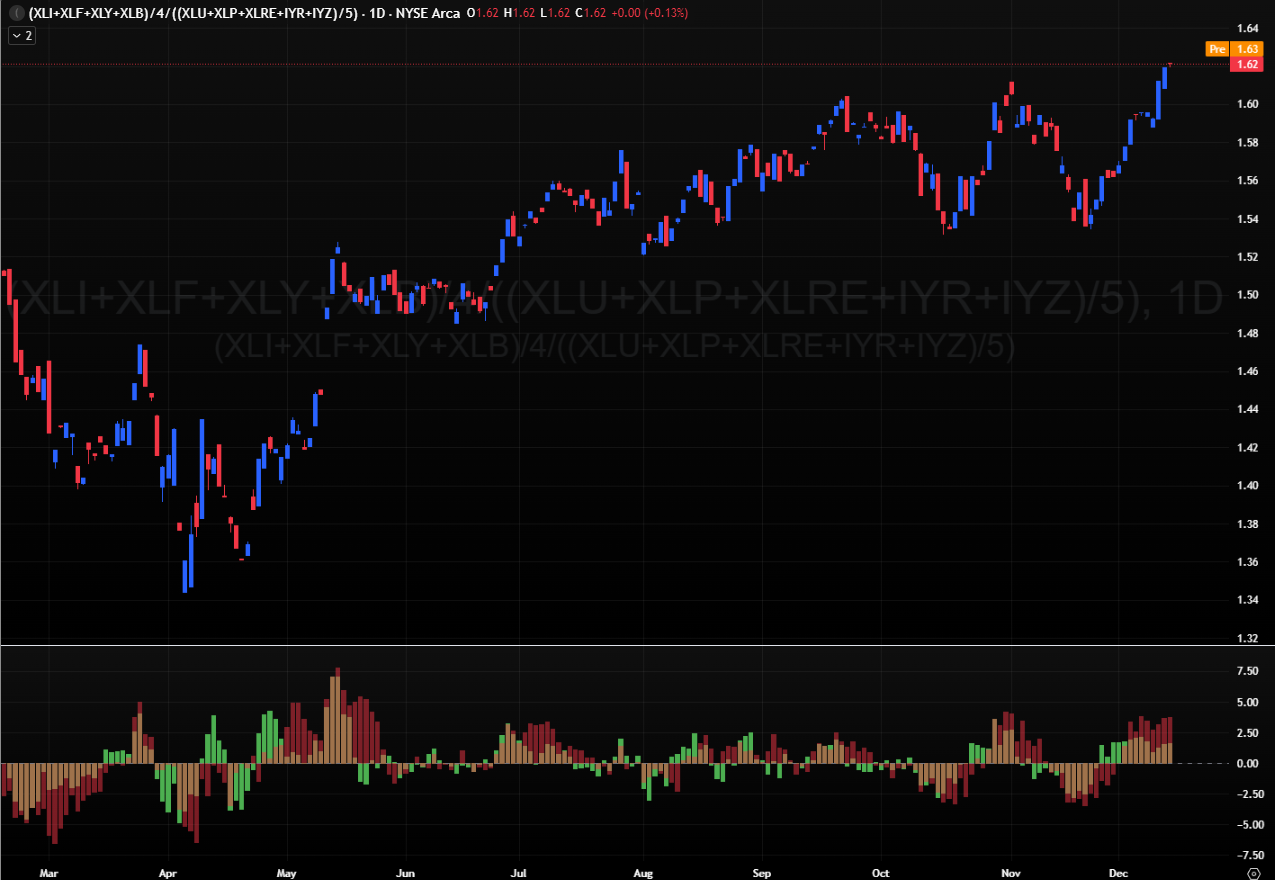
((XLI+XLF+XLY+XLB)/4) / ((XLU+XLP+XLRE+IYR+IYZ)/5)
This ratio is designed to capture a very specific market preference: operating leverage versus equity duration.
The numerator is a deliberately pro-cyclical basket; Industrials (XLI), Financials (XLF), Consumer Discretionary (XLY), and Materials (XLB), sectors that typically thrive when nominal activity is firm, pricing power is present, and higher discount rates are not immediately restrictive.
