
Informational Edge Stacking - Part II
Value vs Growth and High Beta vs Low Vol: Reading the Macro Regime

In Part I (Part I) we started with a single, very simple question:
Is the equity market positioning for acceleration in growth, or quietly bracing for a slowdown?
We answered it by watching how capital moves between Cyclicals and Defensives. When Cyclicals lead, the market is effectively upgrading its expectations for demand and earnings. When Defensives take over, it’s preparing for weaker activity, softer margins, or outright recession risk.
That one ratio alone already gives you a surprisingly good, forward‑looking read on the growth cycle.
But it doesn’t tell you everything.
It doesn’t tell you how the market wants to own that growth in duration terms.
It doesn’t tell you much about the rates and inflation regime sitting underneath.
And it doesn’t tell you whether investors are leaning into risk, or quietly de‑risking while the index still looks fine.
That’s where the next two internal rotations come in:
Value vs Growth – a window into the rates, real‑yield, and inflation backdrop.
High Beta vs Low Vol – a clean read on risk appetite and the forward volatility regime.
Once you layer those on top of Cyclicals vs Defensives, you move from a one‑dimensional “growth up/down” view to something closer to a mosaic:
Growth expectations
Duration preference
Risk appetite
All talking to each other in near real time.

For readers who join on the Annual plan, I’ll also be sharing a set of trading templates and TradingView scripts (including the underlying code for python application).
For those on the Annual Plus plan, you’ll have the additional option of direct calls and guided support as you build and refine your process. This tier is capped at 10 people so I can commit meaningful time to each person.
Value vs Growth: The Real‑Rate and Inflation Filter
When we talk about Value vs Growth, we’re really asking which type of equity cash flow the market prefers:
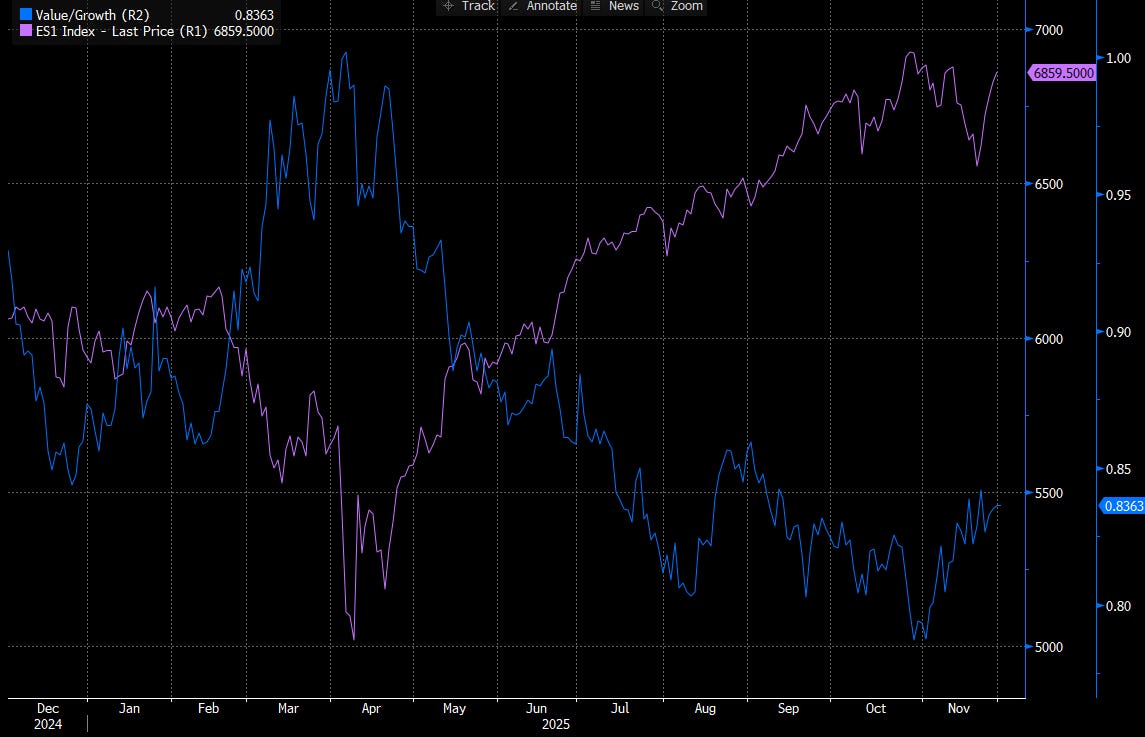
Growth: long‑duration cash flows – secular winners, high‑multiple tech, “story” names whose value lives far out on the horizon. Their valuations are extremely sensitive to the discount rate, especially real yields at the long end of the curve.
Value: cheaper, often more cyclical and capital‑intensive businesses – financials, energy, industrials, materials, classic “old economy” names. They care far more about nominal GDP, pricing power, and the ability to pass through inflation.
So when you look at a Value/Growth ratio (think VLUE vs QQQ or RPV vs VONG), you’re effectively asking:
Does the market want long‑duration, real‑rate‑sensitive growth stories,
or nearer‑term, cyclical, inflation‑linked earnings?
That’s the core intuition. The rest is just mapping how that preference interacts with the bond market and the macro data.
When Growth Leads Value
Keep reading with a 7-day free trial
Subscribe to Global Macro Method to keep reading this post and get 7 days of free access to the full post archives.